

FROM THE PASTOR’S DESK
My Dear Parishioners
When you think about your growth as a Christian, what is the goal? How do you know you’re getting there? We might say: going to Mass, knowing the faith, praying more, being a good person. And all of those things matter. But what are they ultimately preparing us for?
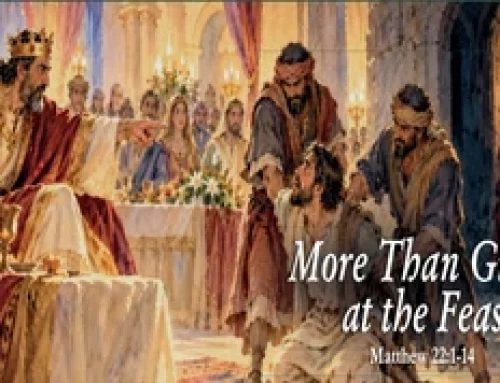
In describing “the kingdom of Heaven”, the parable first explains Heaven’s seating capacity, if you will. God wants everybody there, even though not everyone may end up there.
A wise bishop put it this way: “In imitation of Christ, martyrdom is the pattern for fulfillment as a disciple of Jesus, and so preparation for this heroic witness is the measure for Christian formation.”
Martyrdom comes from a Greek word meaning “to give witness.” We usually think of martyrdom as someone being killed for the faith—and that certainly is martyrdom. But every Christian is called to give heroic witness to Christ. We are being formed not simply to be nicer people or to know more about our faith, but to give our lives to Jesus Christ.
This is what we see in the Christians of Thessalonica in our second reading. Paul arrived there and preached that Jesus was the Messiah, the true Lord of the world. Some people believed, and within weeks they were already facing persecution. In Acts 17, we are told that their opponents make the accusation that these Christians of Thessalonica are “turning the world upside down.”
Why? Because they were saying that Jesus is Lord.
That is the heart of what we hear in the Gospel today. The Pharisees and Herodians ask Jesus whether it is lawful to pay the census tax to Caesar. Jesus asks for a coin, points out Caesar’s image, and says, “Repay to Caesar what belongs to Caesar and to God what belongs to God.” This is about much more than taxes. Caesar claimed to be lord. Caesar claimed the title “son of god.” And Christians were proclaiming something radically different: Jesus is Lord. Jesus is the true Son of God.
So, what does Jesus want from us? Not simply our money. Not merely an hour on Sunday. He wants what belongs to God: you. Your life. Your heart. Your decisions. Your priorities. Jesus calls us to metanoia—a change of mind, a new way of seeing—and to faith: to entrust ourselves completely to him.
That is what happened in Thessalonica. These Christians came to believe that Jesus was truly Lord, and therefore their lives could no longer be organized around the values of the world—power, status, wealth, comfort, or approval. Their lives belonged to Christ. And that kind of faith turned the world upside down.
The same question comes to us: Have I really given my life to Christ? It is possible to be Catholic for years without ever really making that response. We can go to Mass, know our prayers, practice our religion, and yet still have our lives fundamentally organized around something else. But the Christian life is not simply about becoming a slightly better version of ourselves. It is about giving ourselves to Jesus Christ.
And when we actually do that, people notice. We may begin to make different choices. We may refuse things that everyone else considers normal. We may prioritize prayer, family, sacrifice, generosity, chastity, forgiveness, or Sunday worship when those things come at a cost. And sometimes people will not understand. We should not be surprised.
The Thessalonians were persecuted because their faith actually changed the way they lived. The martyrs gave their lives because their faith actually meant something. Their witness was powerful precisely because it cost them something. That is what Christian formation is ultimately preparing us for: not merely to know about Christ, but to belong to Christ so completely that our lives become a witness to him.
And notice how Paul describes the Thessalonians at the beginning of his letter. He speaks of their “work of faith and labor of love and endurance in hope.” Faith, love, hope. That is the Christian life.
So perhaps the question is not simply, “Am I a good Christian?” The deeper question is: If following Jesus cost me something, would I still follow him? Because Jesus does not ask for part of your life. He says, “Repay to God what belongs to God.” And what belongs to God? You. Your whole life.
At every Mass, we are reminded of this. We are the ones who have been called to the Supper of the Lamb. God has called us, invited us, chosen us. And our response to that call is meant to be more than words. It is meant to be our whole life.
And when we give our life to Christ, we become witnesses—people whose faith is not merely something they profess, but something they live. And that kind of witness still has the power to turn the world upside down.
Peace,
Fr. Monteleone
To read the complete bulletin click here